
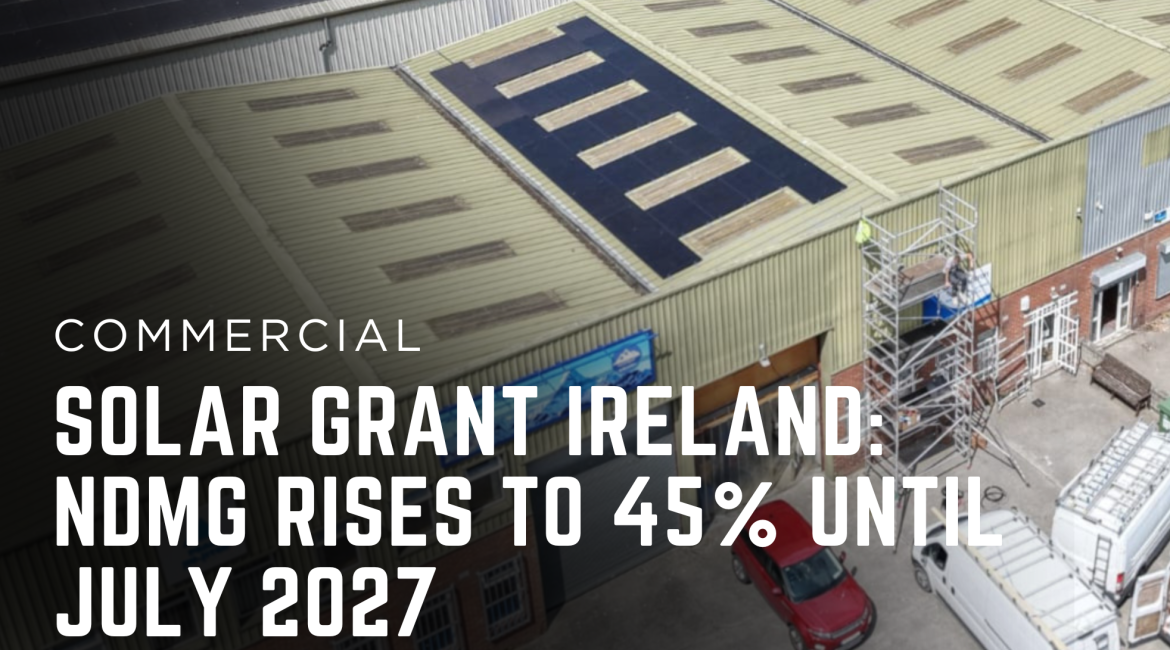
If you run a business, farm, school or community organisation in Ireland, the grant support available for solar PV has just changed significantly — and unlike the domestic changes, this one has a hard deadline.
From 6 October 2026, the Non-Domestic Microgen Grant (NDMG) has been temporarily increased to an effective 45% of eligible costs. That lifts the maximum grant from €162,600 to €325,200. The enhanced rate is available for a nine-month application window that closes on 6 July 2027.
What is the Non-Domestic Microgen Grant?
The NDMG provides financial assistance towards installing solar PV panels to generate electricity on site. It is designed to reduce commercial electricity costs and improve security of supply. Grant funding is available for systems from 1kWp up to a maximum of 1,000kWp.
Who can apply?
- Businesses
- The agricultural sector
- Public sector bodies
- Schools
- Community centres
- Non-profit societies
How much is the grant worth?
The grant is based on the output of your system in kWp, on a banded scale. These are the enhanced rates now in effect:
| System size | Grant value |
|---|---|
| 1kWp | €1,800 |
| 2kWp | €3,600 |
| 3kWp | €4,200 |
| 4kWp – 6kWp | €4,800 |
| 7kWp – 20kWp | €600 per kWp |
| 21kWp – 200kWp | €400 per kWp |
| 201kWp – 1,000kWp | €300 per kWp |
| Maximum grant | €325,200 |
One important detail on payment: when the works are complete you submit an invoice, and SEAI pays the lower of the value on your application summary page or 45% of the invoiced cost.
The deadline, and who misses out
This is where businesses need to pay attention. The enhanced rate is not open-ended and it is not retrospective.
- The enhanced grants are available only for new applications made from 6 October 2026.
- Existing applications will not be increased. Under state aid rules, grandfathering is not permitted.
- Where an applicant has already started works, they have done so on the basis of their existing offer and cannot seek a higher amount.
- The application window closes on 6 July 2027.
If you are holding an older letter of offer and have not yet started works, it is worth discussing your options with SEAI directly before you proceed, because the position differs case by case.
Why solar suits businesses better than homes
This is the part that often gets overlooked. A typical home is empty during the middle of the day — which is exactly when solar generates most — so a lot of domestic generation gets exported rather than used.
Most businesses and farms are the opposite. Your demand curve and your generation curve line up. Refrigeration, milking parlours, workshops, offices, machinery and air conditioning all draw power during daylight hours. The more of your own generation you consume on site rather than exporting, the better the economics.
Payback varies by system size, tariff and usage pattern, so treat any single headline figure with caution — including ours. The right question is not “what is the average payback” but “how much of what I generate will I actually use”.
How to apply, step by step
- Appoint an SEAI-registered Non-Domestic Microgen company. Get quotes from several, and agree a formal contract for the works before you apply.
- Apply to SEAI for a grant offer and wait for your letter of offer. Do not start works before it arrives. Offers are valid for eight months.
- Your installer applies to ESB Networks to connect the system. This must happen before installation and takes at least 4 weeks, or 20 working days.
- Install the system once the ESB Networks connection is approved.
- Your company submits evidence of works to SEAI electronically.
- SEAI processes payment — allow 4 to 6 weeks from receipt of all documentation, longer if an inspection is required.
One further point worth planning for: if you receive more than €10,000 in grants or similar payments from a government department or public authority in a calendar year, you will need a Tax Clearance Certificate.
Start earlier than you think you need to
A 6 July 2027 deadline sounds comfortable until you add up the sequence. Getting quotes, agreeing a contract, applying, waiting for the letter of offer, and the ESB Networks connection application alone can account for a significant part of that window — and the ESB step has a 20 working day minimum before installation can even begin.
The application has to be in before the window closes. Leaving it until spring 2027 is cutting it fine.
Frequently asked questions
Is the 45% rate permanent?
No. It is a temporary increase running from 6 October 2026 to 6 July 2027, introduced as an action of the National Energy Affordability Taskforce.
I applied before October 2026. Can I get the higher rate?
Existing applications cannot be increased, as grandfathering is not permitted under state aid rules. If you have not started works, speak to SEAI about your options.
What is the maximum system size covered?
Grant funding covers systems up to 1,000kWp. Larger systems can still apply, but the grant is capped at the €325,200 maximum.
Does my farm qualify?
Yes, the agricultural sector is explicitly eligible. See our page on agricultural solar grants.
What about tax relief?
Separately from the grant, the Accelerated Capital Allowances scheme allows qualifying companies, sole traders and non-corporates to write off the full purchase value of qualifying energy efficient equipment against profits in the first year, provided the equipment is on the Triple E Register. Check the current position with your accountant.
Talk to us before the window closes
We are an Irish-owned, SEAI-registered installer based in Ashbourne, Co. Meath, working with businesses and farms across Dublin, Meath, Kildare, Louth, Wicklow and the wider Leinster area — from supply yards to childcare settings.
If your electricity bill runs into the thousands each month, this is worth a conversation now rather than in 2027. Get in touch, or read more about business solar grants.
Looking for the domestic grants instead? See our guide to the SEAI solar grant changes for homeowners.
Grant information correct at the time of publication, October 2026. Always confirm current rates, deadlines and conditions on seai.ie before applying.
